5 Unfulfilled Bible Prophecies and Their Meaning
Explore five major Bible prophecies that many Christians believe are yet to be fulfilled, including the Third Temple, the Two Witnesses, Armageddon, God's Kingdom, and Satan's final destruction.

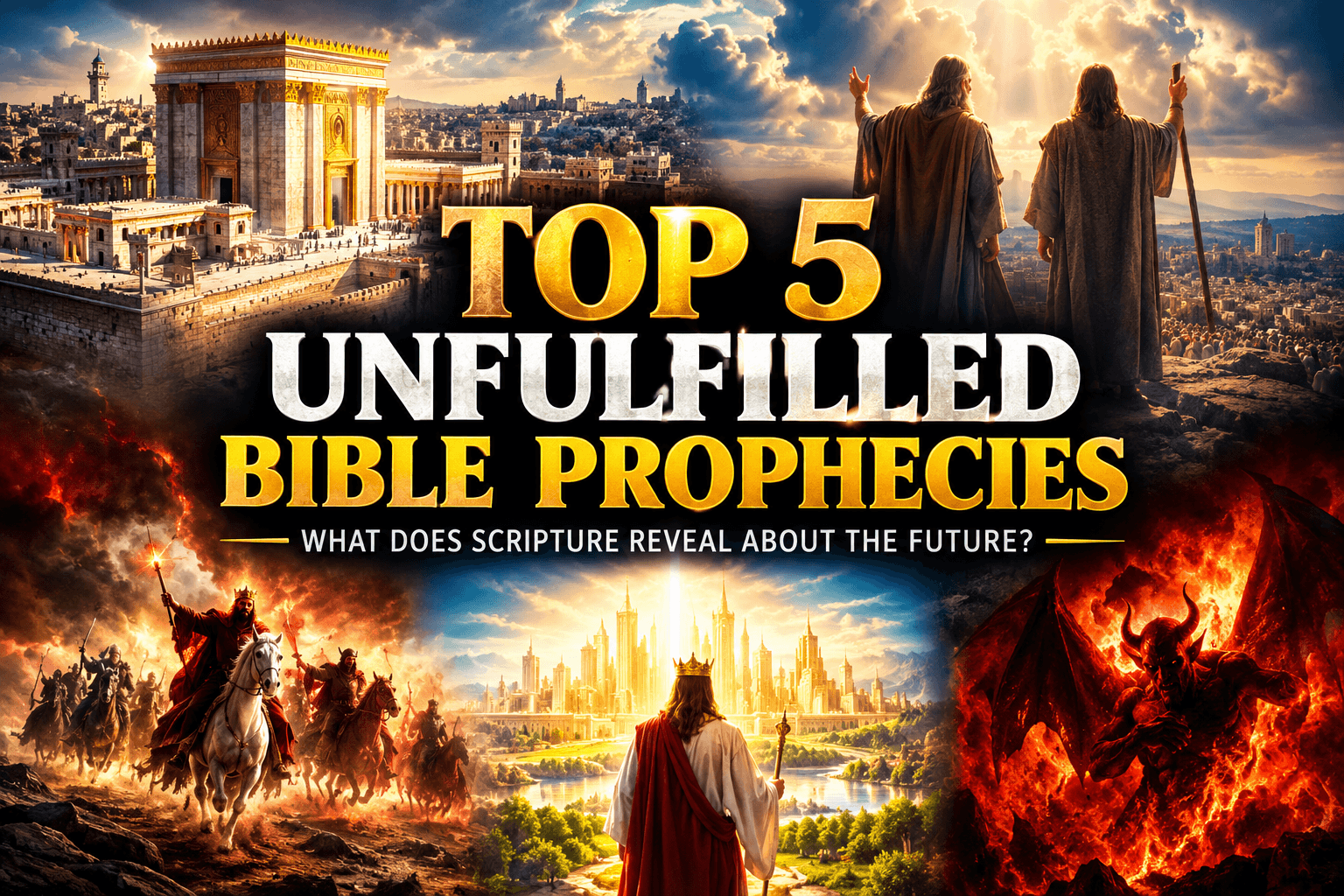
<h2>Top 5 Unfulfilled Bible Prophecies That Could Shape the Future</h2>
<p>The Bible contains powerful prophecies about the future, the return of Jesus Christ, the defeat of evil, and the establishment of God's eternal Kingdom. Some Christians believe that several major prophetic events are still waiting to be fulfilled. But what does Scripture actually say about these events?</p>
<p>From the possibility of a Third Temple in Jerusalem to the final destruction of Satan, these five Bible prophecies offer fascinating insights into biblical teachings about the end times. Let's explore the Scriptures behind each one.</p>
<h2>Number 5: The Building of the Third Jewish Temple</h2>
<p>One of the most discussed subjects in Bible prophecy is the possibility of a Third Jewish Temple in Jerusalem. The first temple, built by Solomon, was destroyed by the Babylonians, while the Second Temple was destroyed by the Romans in AD 70.</p>
<p>Some Christians believe that another temple will be built in Jerusalem before or during the Great Tribulation. They connect this expectation with <strong>2 Thessalonians 2:1–12</strong>, where the apostle Paul describes the man of lawlessness who exalts himself above everything associated with worship and takes his seat in God's temple, proclaiming himself to be God.</p>
<p>Revelation 11:1–2 also describes John receiving a measuring rod and being instructed to measure the temple of God, the altar, and those who worship there. The passage further mentions the holy city being trampled for forty-two months.</p>
<p>Many interpreters understand these passages as referring to a future temple and a period of severe opposition to God. Others interpret the temple imagery symbolically. The exact timing and fulfillment remain subjects of Christian debate.</p>
<p>Nevertheless, the possibility of a Third Temple continues to attract attention among students of biblical prophecy because of its connection with Jerusalem, the Antichrist, and the events described in Revelation.</p>
<h2>Number 4: The Appearance of the Two Witnesses</h2>
<p>Who are the two witnesses described in the Book of Revelation? This is one of the most intriguing questions in end-times prophecy.</p>
<p>According to <strong>Revelation 11:1–14</strong>, God appoints two witnesses to prophesy for 1,260 days, commonly understood by many interpreters as three and a half years. They are given authority to perform extraordinary signs and proclaim their message during a period of great spiritual opposition.</p>
<p>After they complete their testimony, the beast that rises from the abyss makes war against them, overcomes them, and kills them. Their bodies remain in the streets of the great city, and people from different nations look upon them. Revelation 11:9–10 describes the disturbing reaction of those who rejoice over their deaths and exchange gifts because the witnesses had tormented the inhabitants of the earth.</p>
<p>But the story does not end with their deaths. After three and a half days, the breath of life from God enters them, and they stand on their feet. Terror falls upon those who witness this extraordinary event, and the witnesses are called up to heaven.</p>
<p>The identity of the two witnesses is not explicitly named in the passage. Some Christians believe they will be two actual prophets appearing in the future, while others understand them through symbolic interpretations.</p>
<p>Their story highlights an important biblical theme: opposition may silence God's messengers temporarily, but it cannot prevent God from accomplishing His purposes.</p>
<h2>Number 3: The Battle of Armageddon</h2>
<p>The word <strong>Armageddon</strong> appears in Revelation 16:16, where the kings of the earth are gathered at the place called Armageddon. The passage forms part of Revelation's dramatic description of the judgments leading toward the final confrontation between the forces opposed to God and His sovereign rule.</p>
<p>Many Christians understand Armageddon as the final battle associated with Christ's return and God's victory over evil. Revelation 19:11–21 describes Christ as a victorious heavenly warrior who defeats the beast and the kings gathered against Him.</p>
<p>Armageddon is therefore more than a subject of speculation about future wars. Within the wider message of Revelation, it represents the certainty that human rebellion and evil will not ultimately overcome God's authority.</p>
<p>The Bible also describes different forms of divine judgment throughout Scripture, including earthquakes, hail, fire, and other extraordinary events. However, Christians differ on how literally to interpret the imagery and how the events will unfold.</p>
<p>One important message remains clear: the biblical story moves toward God's final victory, not the permanent triumph of human pride or wickedness.</p>
<h2>Number 2: The Establishment of God's Kingdom on Earth</h2>
<p>What kind of government could bring lasting peace to the world? The prophet Daniel described a Kingdom established by God that would never be destroyed or handed over to another people.</p>
<p>In <strong>Daniel 2:44</strong>, Daniel declares that the God of heaven will establish a Kingdom that will crush all other kingdoms and endure forever. Unlike human governments, which rise and fall, God's Kingdom is presented as everlasting.</p>
<p>Christians understand this prophecy in different ways, but many connect it with the reign of Jesus Christ and the fulfillment of God's promises to humanity. Revelation 20:1–6 describes a thousand-year reign of Christ, a passage that forms the basis of the millennial view held by many Christians.</p>
<p>During this period, according to Revelation 20, Satan is bound so that he cannot deceive the nations in the same way. Other biblical passages, including Isaiah 2:2–4 and Isaiah 11:6–9, describe a future characterized by peace, justice, and the knowledge of the Lord.</p>
<p>For believers who anticipate the full establishment of God's Kingdom, this prophecy offers hope beyond the struggles of the present world. It points toward a future in which God's righteous rule will prevail over injustice, violence, and rebellion.</p>
<h2>Number 1: The Final Destruction of Satan</h2>
<p>The Bible's account of Satan does not end with his rebellion or his influence over the world. Revelation 20:7–10 describes a final confrontation after the thousand years have ended.</p>
<p>According to the passage, Satan will be released from his prison and will go out to deceive the nations, described as Gog and Magog. He will gather a vast multitude for battle and lead them against God's people and the beloved city.</p>
<p>However, the rebellion will not succeed. Fire comes down from heaven and devours the gathered forces. The devil is then thrown into the lake of fire and sulfur, where the beast and the false prophet are also described as being judged.</p>
<p>In interpretations that understand the millennium as a future earthly reign, this final rebellion represents a last test of humanity's faithfulness to God. Even after a prolonged period of Christ's rule, Satan's deception leads some to rebel, demonstrating the seriousness of the choice to remain faithful to God.</p>
<p>The passage concludes with Satan's final judgment. Evil will not continue forever, and the devil will not ultimately defeat God's purposes.</p>
<p>For Christians, this prophecy reinforces the hope that God's justice will prevail and that rebellion against Him will finally come to an end. Revelation 21:1–4 then describes a new heaven and a new earth, where God will dwell with His people and wipe away every tear from their eyes.</p>
<h2>What Do These Five Bible Prophecies Mean for Christians Today?</h2>
<p>These five subjects—the Third Temple, the two witnesses, Armageddon, God's Kingdom, and Satan's final destruction—are among the most widely discussed themes in Christian end-times teaching.</p>
<p>Although Christians disagree about the timing, symbolism, and precise fulfillment of certain passages, these prophecies invite readers to study Scripture carefully and reflect on God's sovereignty over history.</p>
<p>Jesus also warned His followers against claiming to know the exact timing of future events. Matthew 24:36 teaches that no one knows the day and hour of His coming except the Father.</p>
<p>Rather than allowing speculation or fear to dominate our lives, we can respond through faith, prayer, obedience, and readiness. The central message of biblical prophecy is not simply to predict what comes next, but to encourage faithfulness to God.</p>
<h2>Conclusion: God's Victory Will Have the Final Word</h2>
<p>From the prophecies surrounding Jerusalem to the final judgment of Satan, the Bible presents a story that moves toward God's ultimate victory over evil.</p>
<p>Some of these events are understood literally by many Christians, while others are interpreted symbolically or differently across Christian traditions. Studying the passages in their context helps us distinguish what Scripture explicitly says from interpretations about how the future will unfold.</p>
<p>Ultimately, the hope offered by the Bible is that evil will not reign forever, God's purposes will stand, and His promises will be fulfilled according to His will.</p>
<p><strong>Which of these five Bible prophecies interests you the most?</strong> Share your thoughts in the comments, and continue exploring biblical prophecy and the teachings of Scripture with The Gospel Anchor.</p> ```