How to Overcome Procrastination Biblically
Procrastination can keep you trapped in fear, perfectionism, and unfinished plans. Discover what the Bible teaches about using your time wisely, overcoming fear, and taking practical steps of faith.

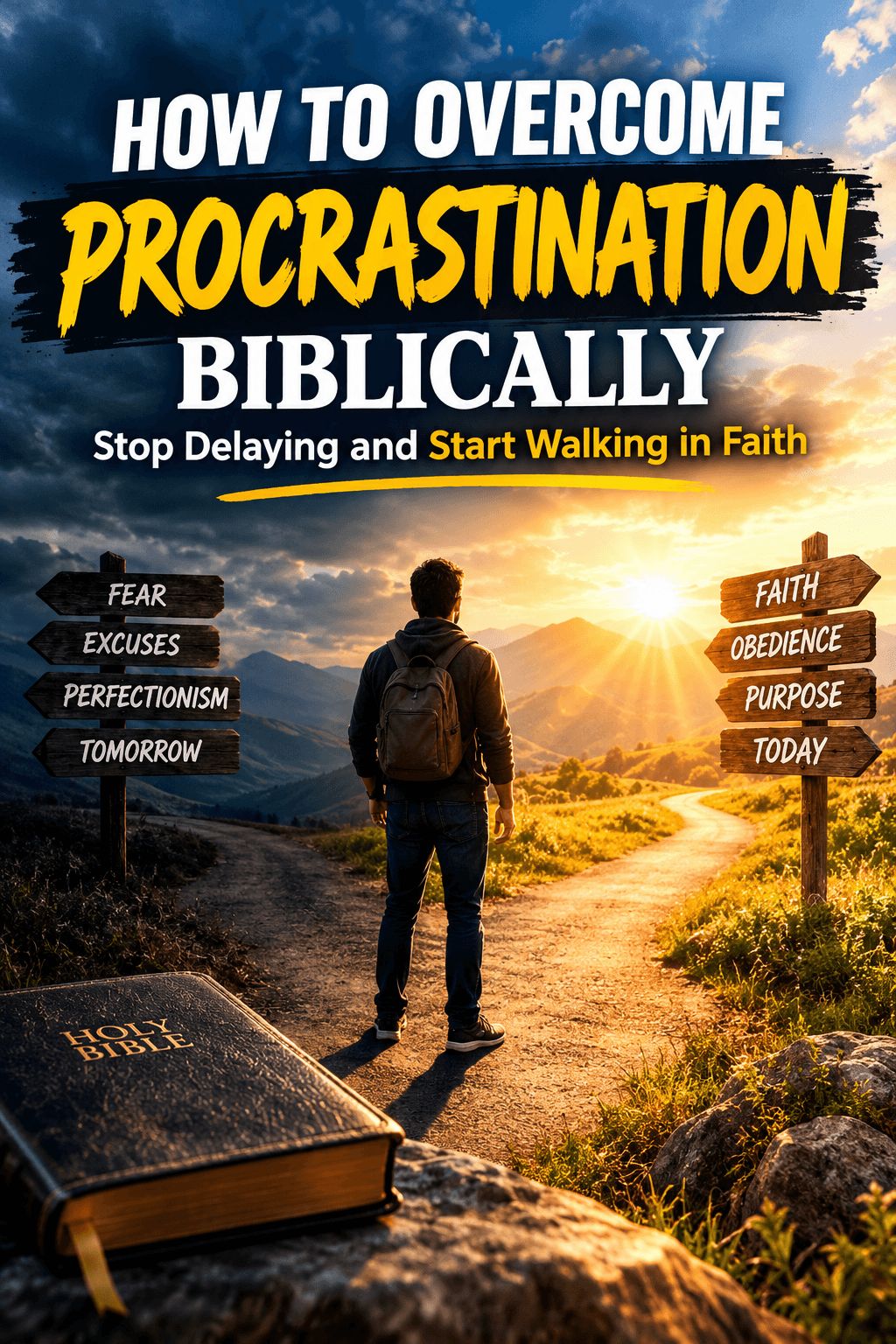
<h2>How to Overcome Procrastination Biblically: Stop Delaying and Start Walking in Faith</h2>
<p>Have you ever known exactly what you needed to do but kept putting it off? Maybe there is a difficult conversation you have been avoiding, a project that has been sitting unfinished for weeks, or a dream you believe God placed in your heart that you keep promising to pursue tomorrow.</p>
<p>You tell yourself you will start when you have more time, when you feel more confident, or when everything finally falls into place. But tomorrow arrives, and the same task remains unfinished.</p>
<p>If this sounds familiar, you are not alone. Procrastination is a struggle many people face. Sometimes it comes from fear, perfectionism, uncertainty, or simply feeling overwhelmed. For Christians, it can also become a spiritual challenge when repeated delays prevent us from using our gifts, serving others, or acting on responsibilities we know we should address.</p>
<p>The good news is that <strong>you do not have to remain trapped in the cycle of delay.</strong> Through biblical wisdom, prayer, practical discipline, and trust in God, you can learn to overcome procrastination and begin taking meaningful steps toward the things that matter.</p>
<h2>What Does the Bible Say About Procrastination?</h2>
<p>Although the Bible does not use the modern term <em>procrastination</em> in the way we commonly use it today, it speaks clearly about diligence, wisdom, responsibility, and making good use of our time.</p>
<p>Ephesians 5:15–16 reminds us:</p>
<blockquote> <p>"See then that ye walk circumspectly, not as fools, but as wise, Redeeming the time, because the days are evil." (KJV)</p> </blockquote>
<p>This passage encourages believers to live thoughtfully and make the most of the opportunities available to them. It reminds us that our time is valuable and that we should not live carelessly or allow important responsibilities to slip away through unnecessary delay.</p>
<p>Procrastination can make us behave as though we have unlimited time. We assume there will always be another opportunity, another convenient moment, or another day to begin.</p>
<p>But none of us knows everything tomorrow will bring. Proverbs 27:1 warns us not to boast about tomorrow because we do not know what a day may bring. The lesson is not that we should rush into every decision without thinking. Rather, it is that we should not presume tomorrow is guaranteed or use the uncertainty of the future as an excuse to avoid the responsibilities of today.</p>
<p><strong>The time to take the next wise step is not always when you feel ready. Sometimes it is when you recognize what needs to be done and choose to begin.</strong></p>
<h2>1. Remember That God Can Help You Even When You Feel Unqualified</h2>
<p>One of the most common reasons people procrastinate is the feeling that they are not ready.</p>
<p>You may believe you lack the necessary skills, experience, confidence, or resources. You may look at what lies ahead and feel overwhelmed before you have even started.</p>
<p>This is not a new struggle. When God called Moses to lead the Israelites out of Egypt, Moses responded with objections. He questioned his ability to speak effectively and wondered why God would choose him for such a demanding assignment.</p>
<p>In Exodus 4:10, Moses explained that he was not eloquent and struggled with speaking. God assured Moses that He would help him speak and teach him what to say (Exodus 4:11–12).</p>
<p>Moses' story reminds us that feeling inadequate does not automatically mean we should abandon a responsibility. Sometimes we need to learn, prepare, seek counsel, and take a step forward while depending on God's help.</p>
<p>You may not know how to complete the entire project, resolve every problem, or accomplish every part of your goal. But you may already know the next step you can take.</p>
<p>Perhaps you need to make one phone call, write the first paragraph, learn a new skill, or ask someone for guidance.</p>
<p>Instead of waiting until you feel completely qualified, ask God for wisdom and courage to begin.</p>
<p><strong>You do not need to know every step of the journey before taking the next one.</strong></p>
<h2>2. Stop Waiting for the Perfect Time</h2>
<p>How often have you postponed something because the timing did not feel right?</p>
<p>You promise yourself that you will begin next Monday, start after the holidays, or finally take action when life becomes less complicated. Unfortunately, life does not always become less complicated. New responsibilities appear, unexpected problems arise, and the perfect moment may never come.</p>
<p>Proverbs 27:1 reminds us that tomorrow is uncertain. This truth encourages us to approach today with wisdom rather than assuming that every opportunity will remain available indefinitely.</p>
<p>Consider Esther's story. When the Jewish people faced a deadly threat, Esther was confronted with a difficult decision. Approaching the king without being summoned could put her own life at risk.</p>
<p>Mordecai challenged her to consider the possibility that she had come to her royal position for that very moment. Esther 4:14 records his famous words:</p>
<blockquote> <p>"And who knoweth whether thou art come to the kingdom for such a time as this?" (KJV)</p> </blockquote>
<p>Esther had to decide whether to remain silent or act despite her fear. She eventually asked the Jewish people to fast and then approached the king.</p>
<p>Her story illustrates the importance of recognizing when a moment calls for courage and responsible action.</p>
<p>Not every opportunity is an instruction from God, and not every delay is wrong. Some decisions require prayer, preparation, and patience. However, when you have carefully considered a responsibility and know the next appropriate step, do not let the desire for perfect conditions keep you motionless.</p>
<p>Sometimes progress begins when you stop waiting for life to become easier and start working wisely with the circumstances you have.</p>
<h2>3. Recognize How Fear and Perfectionism Fuel Procrastination</h2>
<p>Procrastination does not always look like laziness. Sometimes it looks like excessive planning, endless research, repeated revisions, or constantly waiting until you feel more confident.</p>
<p>You may be afraid of making a mistake. You may worry about what other people will think. You may fear that your work will not meet your expectations.</p>
<p>As a result, you delay starting because starting makes failure feel possible.</p>
<p>Perfectionism can create this trap. When you believe that something must be flawless before it is worth doing, you may find yourself doing nothing at all.</p>
<p>The story of the servant who buried his talent in Matthew 25:14–30 offers an important lesson. In Jesus' parable, a servant entrusted with one talent hid it in the ground rather than putting it to use. When the master returned, the servant explained that he had been afraid.</p>
<p>The problem was not simply that the servant had failed to achieve an impressive result. He had refused to use what had been entrusted to him.</p>
<p>The parable challenges us to think carefully about how fear affects our response to our responsibilities and opportunities.</p>
<p>Are you burying a gift because you are afraid it will not be good enough? Are you avoiding a meaningful task because you cannot guarantee the outcome?</p>
<p>God does not require you to control every result. You are responsible for acting wisely with what you have been given.</p>
<p>That may mean producing a first draft, starting a small project, asking for feedback, or taking a reasonable risk after careful consideration.</p>
<p>You can improve your work as you learn. You can correct mistakes as you discover them.</p>
<p><strong>Do not allow the pursuit of perfection to prevent you from making meaningful progress.</strong></p>
<h2>4. Start Small and Be Faithful in What You Can Do Today</h2>
<p>One of the most effective ways to overcome procrastination is to stop focusing only on the size of the entire task.</p>
<p>A major goal can feel intimidating when you think about everything it requires. Breaking it into smaller actions makes it easier to begin.</p>
<p>Jesus said in Luke 16:10:</p>
<blockquote> <p>"He that is faithful in that which is least is faithful also in much." (KJV)</p> </blockquote>
<p>This principle reminds us that small responsibilities matter. Faithfulness is not demonstrated only through extraordinary achievements. It is also reflected in the ordinary choices we make every day.</p>
<p>If you want to write a book, begin by writing one page.</p>
<p>If you need to organize your finances, start by listing your income, expenses, and outstanding obligations.</p>
<p>If you have been avoiding an important conversation, begin by writing down what you need to communicate honestly and respectfully.</p>
<p>If you want to grow spiritually, set aside a specific time to pray and study Scripture rather than waiting for a perfect devotional routine.</p>
<p>Small actions may not produce dramatic results immediately, but they can help build consistency and confidence.</p>
<p>The goal is not to finish everything in one day. It is to stop allowing the size of the task to prevent you from taking the first step.</p>
<p>Instead of asking, "How will I accomplish all of this?" ask yourself, "What is one useful thing I can do next?"</p>
<p>Then do it.</p>
<h2>5. Learn From Nehemiah: Pray, Plan, and Take Action</h2>
<p>Prayer is essential to the Christian life, but prayer and responsible action are not enemies.</p>
<p>Nehemiah provides a powerful example of bringing a burden before God and then acting with wisdom.</p>
<p>When Nehemiah heard that Jerusalem's walls had been broken down and its gates burned, he was deeply distressed. He wept, mourned, fasted, and prayed before God (Nehemiah 1:3–11).</p>
<p>But he did not stop at feeling burdened.</p>
<p>Nehemiah eventually approached the king, explained the situation, requested permission to go to Jerusalem, and sought the resources he needed. He later assessed the damaged walls and organized the people to rebuild them.</p>
<p>His story shows a combination of prayer, planning, courage, and practical work.</p>
<p>Nehemiah did not need to have every detail resolved before beginning. He took the next appropriate step and continued working through the challenges that followed.</p>
<p>This is a valuable lesson for anyone struggling with procrastination.</p>
<p>Pray for direction, but also consider what preparation is necessary. Ask God for wisdom, but be willing to make the phone call, complete the application, learn the skill, or begin the work.</p>
<p>Faith does not require you to ignore practical responsibilities. Instead, faith can shape how you approach them.</p>
<p>When you feel stuck, try this simple pattern:</p>
<ol> <li>Pray for wisdom and clarity.</li> <li>Identify the most important next step.</li> <li>Break that step into something manageable.</li> <li>Set aside a specific time to do it.</li> <li>Review your progress and adjust when necessary.</li> </ol>
<p>You may be surprised by how much becomes possible when you combine dependence on God with consistent action.</p>
<h2>6. Remember That Your Actions Can Affect Other People</h2>
<p>It is easy to assume that procrastination affects only us. We think about the project we have not completed, the goal we have not reached, or the personal opportunity we have delayed.</p>
<p>But our choices can also affect the people around us.</p>
<p>A delayed apology may prolong a painful disagreement. An unfinished responsibility may place additional pressure on a colleague or family member. Failing to prepare for something important may create difficulties for others who depend on us.</p>
<p>Esther's story also reminds us that our decisions can have consequences beyond our personal circumstances.</p>
<p>Mordecai's words in Esther 4:14 challenged Esther to consider the purpose and responsibility associated with her position. She could not control every outcome, but she could decide how to respond to the situation before her.</p>
<p>This does not mean every dream or idea must be treated as a divine assignment. Nor does it mean you should accept every responsibility that comes your way.</p>
<p>It means you should consider whether unnecessary delay is preventing you from fulfilling a genuine responsibility or using your abilities to help others.</p>
<p>Perhaps someone is waiting for you to keep a promise, complete an important task, offer encouragement, or take the first step toward reconciliation.</p>
<p>Your action may matter more than you realize.</p>
<h2>7. Change the Way You Speak About Your Responsibilities</h2>
<p>The words you use to describe a task can influence how you approach it.</p>
<p>When you repeatedly tell yourself, "I have to do this," the task may begin to feel like an unwanted burden. Sometimes this reflects a genuine problem, especially when you are overwhelmed or carrying too many responsibilities.</p>
<p>However, changing your perspective can help when the task is meaningful but you have been avoiding it.</p>
<p>Instead of thinking, "I have to learn this skill," try, "I have an opportunity to learn something that could help me grow."</p>
<p>Instead of saying, "I have to work on this project," remind yourself, "I can make progress toward something important today."</p>
<p>This is not about pretending every responsibility is enjoyable. Some necessary tasks remain difficult, tiring, or inconvenient.</p>
<p>It is about recognizing the value behind the effort.</p>
<p>Colossians 3:23 encourages believers to work wholeheartedly, as unto the Lord rather than merely for human approval.</p>
<p>When you approach your responsibilities with this attitude, even ordinary work can become an opportunity to practice faithfulness, integrity, and service.</p>
<p>You may not always feel motivated. But you can still choose a wise action that reflects what matters to you.</p>
<h2>8. Stop Waiting for Motivation Before You Begin</h2>
<p>Many people believe they must feel motivated before they can take action. They wait for inspiration to arrive, confidence to increase, or fear to disappear.</p>
<p>But motivation is not always present at the beginning of meaningful work. Sometimes it grows after you have started.</p>
<p>Think about a person learning to pray consistently, developing a new skill, or rebuilding a neglected project. The first few attempts may feel difficult. Progress may be slow, and the results may not immediately meet expectations.</p>
<p>Yet repeated effort can gradually make the process more familiar and manageable.</p>
<p>This is why it helps to establish a simple routine instead of depending entirely on your emotions.</p>
<ul> <li>Choose a realistic time to work.</li> <li>Remove unnecessary distractions.</li> <li>Prepare the materials you need.</li> <li>Decide what you will accomplish during the next 15 or 20 minutes.</li> <li>Begin, even if you do not feel completely ready.</li> </ul>
<p>You do not need to complete the entire assignment during that period. Your goal is to create movement where there was previously avoidance.</p>
<p>If the task is emotionally difficult, acknowledge that difficulty rather than condemning yourself for experiencing it. You can ask for help, adjust the task, or take a brief break when needed.</p>
<p>The important thing is to distinguish a genuine need for rest or preparation from a repeated pattern of avoidance.</p>
<p><strong>You can feel uncertain and still take a wise step forward.</strong></p>
<h2>9. Trust God's Timing Without Using It as an Excuse for Delay</h2>
<p>Christians often speak about waiting on God's timing, and there are seasons when patience is necessary.</p>
<p>Some opportunities require preparation. Some decisions need careful discernment. Some circumstances are outside our control, and forcing an outcome can create unnecessary harm.</p>
<p>But waiting on God should not automatically become a reason to avoid the responsibilities that are already clear.</p>
<p>For example, you may be praying for a better career while refusing to update your CV or apply for suitable positions. You may be asking God to restore a relationship while refusing to acknowledge your part in a disagreement. You may be praying for spiritual growth while consistently neglecting time in God's Word.</p>
<p>Prayer can help you find direction, but it should not become a substitute for every practical step.</p>
<p>James 2:17 explains that faith without works is dead. In its context, James is discussing the relationship between genuine faith and the actions that demonstrate it.</p>
<p>The lesson is not that we earn God's favor through productivity. Rather, genuine faith should influence how we live and respond to the responsibilities before us.</p>
<p>You can trust God with the outcome while doing your part faithfully.</p>
<p>You can pray for provision while managing your resources wisely. You can pray for opportunities while preparing yourself to recognize and pursue them. You can ask for wisdom while taking time to learn and make responsible decisions.</p>
<p>Waiting is sometimes necessary. Avoidance is not the same as waiting faithfully.</p>
<h2>10. Your Practical Challenge: Take One Step Today</h2>
<p>Now bring this message into your own life.</p>
<p>Think about one thing you have been postponing. It may be a goal, a responsibility, a difficult conversation, or a project you have been afraid to begin.</p>
<p>You do not need to solve every problem today. You do not need to make a dramatic announcement or accomplish something extraordinary.</p>
<p>You simply need to identify the next wise step.</p>
<ul> <li>If you have been delaying a phone call, schedule it or prepare what you need to say.</li> <li>If you have been avoiding a project, spend 15 minutes making a start.</li> <li>If you have been putting off an important application, gather the required information and complete one section.</li> <li>If you need to apologize, reflect honestly on what happened and consider how you can approach the conversation with humility and respect.</li> <li>If you are uncertain about what God is asking of you, take time to pray, study Scripture, seek trustworthy counsel, and examine the situation carefully.</li> </ul>
<p>Then choose one action that is realistic and appropriate.</p>
<p>Do not measure your progress only by how much you accomplish in a single day. Measure it also by your willingness to stop avoiding what matters and begin moving forward with wisdom.</p>
<p>You may still feel nervous. You may still have questions. You may even need to change your plan along the way.</p>
<p>That is all right. You are allowed to learn as you go.</p>
<h2>A Prayer for Overcoming Procrastination</h2>
<p>Heavenly Father, thank You for the time, abilities, and opportunities You have entrusted to me.</p>
<p>Please help me recognize the difference between wise patience and unnecessary delay. Show me where fear, perfectionism, distraction, or uncertainty has been preventing me from taking the next appropriate step.</p>
<p>Give me wisdom to understand my responsibilities, courage to face difficult tasks, and discipline to use my time well.</p>
<p>When I feel inadequate, remind me that I can seek Your guidance and ask others for help. When I become overwhelmed, teach me to break large tasks into manageable steps. When I make mistakes, help me learn rather than give up.</p>
<p>Lord, help me become more faithful in the small things. Teach me to work with integrity, serve others with love, and trust You with the outcomes I cannot control.</p>
<p>Help me begin what needs to be started, finish what needs to be completed, and have the wisdom to recognize when I need to rest, prepare, or change direction.</p>
<p>I surrender my fears and plans to You. Guide my decisions and help me take the next step with faith and humility.</p>
<p>In Jesus' name, Amen.</p>
<h2>Conclusion: Stop Delaying and Start Walking in Faith</h2>
<p>Procrastination can keep you trapped in a cycle of good intentions and unfinished plans. It can make difficult tasks feel even more intimidating and cause you to miss opportunities to grow, serve, and fulfill your responsibilities.</p>
<p>But you can begin changing that pattern.</p>
<p>The Bible reminds us to use our time wisely, remain faithful in small things, learn from those who acted courageously, and trust God when we feel inadequate.</p>
<p>Remember Moses, who needed God's help. Remember Esther, who chose courage at a critical moment. Remember Nehemiah, who combined prayer with practical action.</p>
<p>Their stories remind us that meaningful action does not require perfect confidence or complete control over the future.</p>
<p>So ask yourself one final question: <strong>What is one thing I can do today that I have been putting off for too long?</strong></p>
<p>Identify it. Pray for wisdom. Make a realistic plan. Then take the first step.</p>
<p>You do not have to accomplish everything today, and you do not have to do everything perfectly.</p>
<p>You simply have to stop allowing unnecessary fear to make every decision for you.</p>
<p><strong>Start small. Act wisely. Remain faithful. Trust God with the rest.</strong></p>