Why Did Michael and Satan Fight Over Moses' Body?
The Bible reveals a mysterious confrontation between Michael the archangel and Satan over the body of Moses. Why was his body so important, and why did Michael respond with the words, "The Lord rebuke you"? Discover the fascinating biblical mystery behind Jude 1:9 and the powerful lessons it teaches about God's authority, humility, and spiritual warfare.

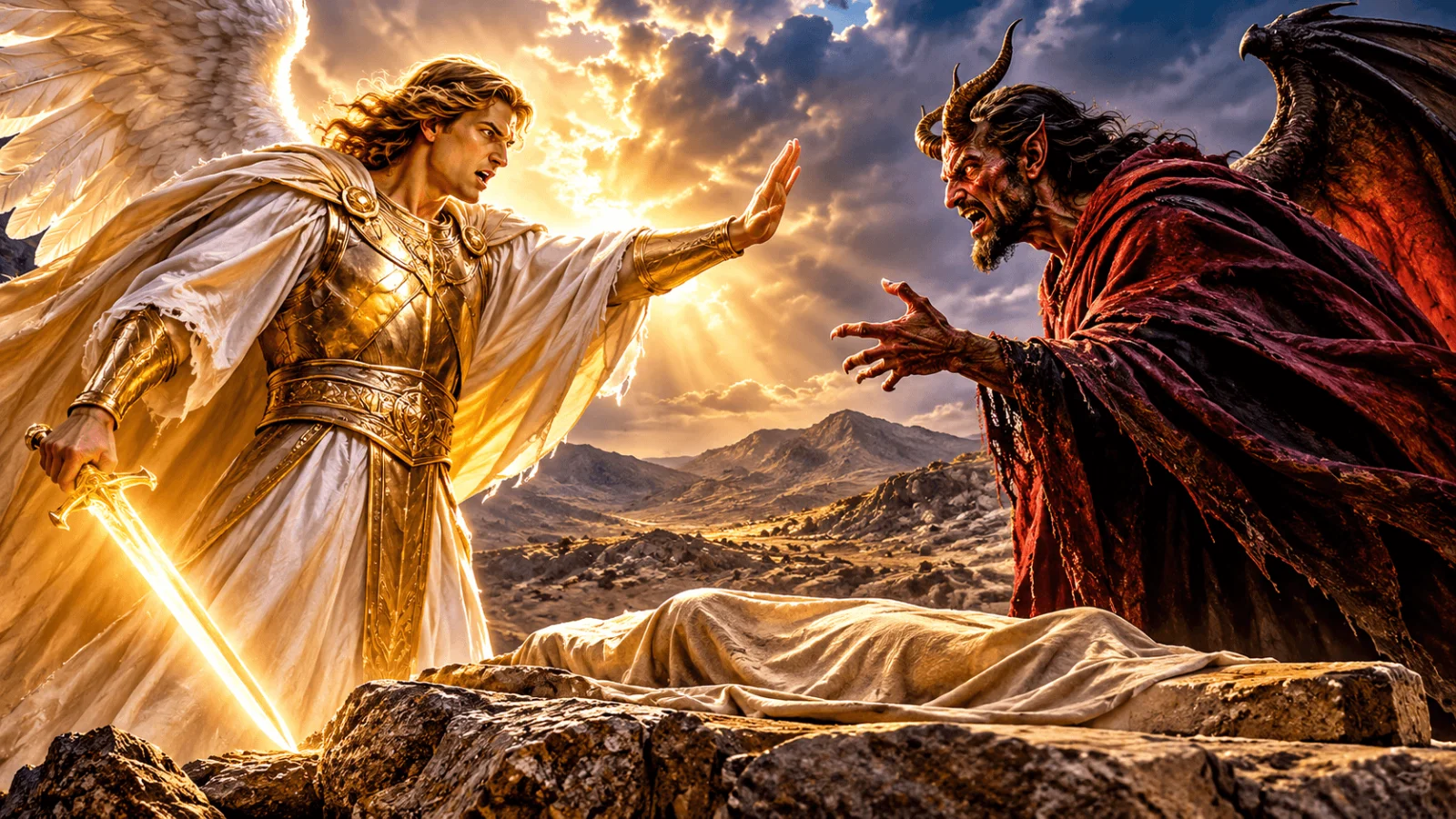
<h1>The Mystery of Moses' Burial: Why Did Michael and Satan Fight Over His Body?</h1>
<p>Imagine a battle taking place in the unseen spiritual realm, not over a kingdom, a throne, or a treasure, but over the body of a man who had already died.</p>
<p>This was no ordinary man. His name was Moses, the great servant of God who confronted Pharaoh, led Israel out of Egyptian slavery, received the Ten Commandments, and guided God's people through the wilderness for forty years.</p>
<p>Yet, when his journey finally came to an end, something extraordinary happened. God Himself took responsibility for his burial. And according to one of the most mysterious passages in the New Testament, an unexpected confrontation took place over his body.</p>
<p>On one side was Michael the archangel. On the other was Satan, the adversary.</p>
<p>What could possibly have made the body of a dead man so important that these two spiritual beings would dispute over it? Why did Satan want Moses' body? And why did Michael respond with the surprising words, "The Lord rebuke you"?</p>
<p>The answer takes us into one of the Bible's most fascinating mysteries. But beyond the mystery itself lies a powerful lesson about God's authority, spiritual warfare, humility, and the importance of remaining faithful to Him.</p>
<h2>1. The Unusual Death and Burial of Moses</h2>
<p>To understand the mysterious confrontation in Jude 1:9, we must first understand who Moses was and why his death was so significant.</p>
<p>Moses was not simply another leader in Israel. He was the man God chose to confront Pharaoh and demand the release of the Israelites from slavery in Egypt. Through him, God performed extraordinary signs, divided the Red Sea, provided food in the wilderness, and established His covenant with Israel.</p>
<p>His relationship with God was also remarkable.</p>
<p>Exodus 33:11 tells us that the Lord spoke with Moses face to face, as someone speaks with a friend. This expression describes an unusually direct and intimate relationship with God, setting Moses apart as a remarkable servant in Israel's history.</p>
<p>But despite his extraordinary calling, Moses was not permitted to enter the Promised Land.</p>
<p>At Meribah, the Israelites complained because they had no water. God instructed Moses to speak to the rock so that water would come out. However, Moses became angry, struck the rock twice with his staff, and failed to honor God as holy before the people.</p>
<p>Although water came out, the Lord told Moses and Aaron that they would not lead the assembly into the land He had promised.</p>
<p>This account is recorded in Numbers 20:1-13.</p>
<p>It is a sobering reminder that even great spiritual leaders are accountable to God. Moses had served faithfully for many years, but his position did not exempt him from the consequences of disobedience.</p>
<p>Eventually, Moses climbed Mount Nebo, where God showed him the Promised Land from a distance. He could see the destination toward which he had spent much of his life leading the Israelites, but he would never enter it.</p>
<p>Then Moses died.</p>
<p>Deuteronomy 34:5-6 records something extraordinary: Moses died in the land of Moab, and God buried him in a valley opposite Beth-peor. Even more mysteriously, no one knew the location of his grave.</p>
<p>Think about that for a moment. Moses was one of the most important figures in Israel's history, yet his burial place remained unknown.</p>
<p>Why would God allow such an unusual burial?</p>
<p>The Bible does not explicitly explain every reason, but concealing the grave meant that it could not become an obvious national shrine or a place where people might direct worship toward Moses rather than God.</p>
<p>And this brings us to the passage that makes the story even more mysterious.</p>
<h2>2. The Hidden Battle Between Michael and Satan</h2>
<p>Most people who read the story of Moses' death in Deuteronomy might assume that his burial was the end of his earthly journey. However, a short passage in the New Testament reveals another remarkable detail.</p>
<p>Jude 1:9 says:</p>
<blockquote> <p>"But even the archangel Michael, when he was disputing with the devil about the body of Moses, did not himself dare to condemn him for slander but said, 'The Lord rebuke you!'"</p> <p><strong>— Jude 1:9 (NIV)</strong></p> </blockquote>
<p>Let that sink in.</p>
<p>Michael, one of the most prominent angels mentioned in Scripture, was involved in a dispute with Satan over the body of Moses.</p>
<p>This is particularly interesting because the book of Deuteronomy does not mention this confrontation. It simply tells us that Moses died and that his burial place remained unknown.</p>
<p>Jude gives us a glimpse into an event that is otherwise not described in the biblical account of Moses' death.</p>
<p>But notice something important about Michael's response.</p>
<p>He did not insult Satan. He did not boast about his own authority. He did not pronounce a personal judgment against him.</p>
<p>Instead, he said, "The Lord rebuke you!"</p>
<p>Why would such a powerful archangel respond this way?</p>
<p>Because the passage emphasizes that judgment and authority ultimately belong to God. Michael did not act as though he possessed independent authority to condemn the devil. He appealed to the authority of the Lord.</p>
<p>This detail is especially important because Jude was warning believers against arrogance, false teaching, and speaking recklessly about spiritual matters.</p>
<h2>3. Why Was Satan Interested in Moses' Body?</h2>
<p>Now we arrive at the question that makes this passage so fascinating.</p>
<p>Why would Satan want the body of Moses?</p>
<p>The Bible tells us that a dispute took place, but it does not directly explain Satan's motive. Therefore, any explanation must be understood as an interpretation rather than an established biblical fact.</p>
<p>Nevertheless, there are several ways Christians have understood this mysterious confrontation.</p>
<h3>Could Satan Have Wanted to Use Moses' Body to Promote Idolatry?</h3>
<p>One commonly discussed interpretation is that Satan may have wanted Moses' body to become an object of worship or religious devotion.</p>
<p>Consider who Moses was to the Israelites. He was the man who led them out of Egypt, received the Law, and stood between the people and God during some of the most difficult moments in their history.</p>
<p>His reputation was enormous.</p>
<p>If his burial place had become publicly known, people might have been tempted to turn it into a shrine, treating his remains as sacred objects or directing religious devotion toward him.</p>
<p>We should be careful, however, not to claim that Scripture explicitly identifies this as Satan's plan. It is a possible interpretation, not something Jude directly tells us.</p>
<h3>Could the Dispute Have Involved Satan's Accusations Against Moses?</h3>
<p>Another interpretation focuses on Satan's identity as the accuser.</p>
<p>Throughout Scripture, Satan is portrayed as an adversary who accuses and opposes God's people.</p>
<p>In Job 1:6-12, Satan appears before God and challenges Job's integrity. In Zechariah 3:1-2, Satan stands ready to accuse Joshua the high priest, but the Lord rebukes him.</p>
<p>This second passage is particularly interesting because it uses language similar to Jude 1:9.</p>
<p>Could Satan have been bringing accusations against Moses because of his disobedience at Meribah?</p>
<p>It is an interesting possibility. Moses had indeed failed at a critical moment, and he was held accountable for that failure. However, Jude does not tell us that this was the specific subject of Satan's argument.</p>
<p>What we can confidently understand is that the dispute demonstrates Satan's opposition and Michael's refusal to act beyond the authority of God.</p>
<h3>Was Satan Challenging God's Authority Over Moses?</h3>
<p>There is another important way to understand the story.</p>
<p>Moses belonged to God. His life, calling, ministry, and final resting place were all under God's authority.</p>
<p>Whatever Satan's intention may have been, Michael's response points us toward a central truth: Satan does not possess ultimate authority. God does.</p>
<p>The mystery is fascinating, but the most important message is not the exact reason Satan wanted Moses' body. It is the authority of the Lord over every spiritual adversary.</p>
<h2>4. Why Didn't Michael Destroy Satan Immediately?</h2>
<p>One question naturally follows: If Michael was such a powerful archangel, why didn't he simply destroy Satan?</p>
<p>Why did he say, "The Lord rebuke you," instead of taking matters into his own hands?</p>
<p>The answer is found in the very point Jude was making.</p>
<p>Michael demonstrated restraint. He did not speak as though his own power was the ultimate authority in the spiritual realm.</p>
<p>Even when confronting the devil, he appealed to the judgment and authority of God.</p>
<p>This is not a declaration that Michael was powerless. Rather, the passage highlights his refusal to make an arrogant or abusive judgment.</p>
<p>There is a powerful lesson here for believers.</p>
<p>Spiritual warfare is not about becoming boastful, making dramatic declarations, or imagining that human strength can overcome every spiritual challenge. It is about depending on God.</p>
<p>James 4:7 gives believers a clear instruction:</p>
<blockquote> <p>"Submit yourselves therefore to God. Resist the devil, and he will flee from you."</p> <p><strong>— James 4:7 (KJV)</strong></p> </blockquote>
<p>Notice the order: submit to God first, then resist the devil.</p>
<p>Our confidence does not come from our ability to intimidate spiritual forces. It comes from belonging to the One whose authority is greater than every other power.</p>
<h2>5. What Does the Battle Over Moses' Body Teach Us About Spiritual Warfare?</h2>
<p>Although the confrontation described in Jude 1:9 happened in connection with Moses, its lessons are relevant to Christians today.</p>
<p>Many people imagine spiritual warfare only as dramatic supernatural encounters. But the Bible also describes a struggle involving our faith, decisions, character, obedience, and commitment to God.</p>
<p>Here are some important lessons from this mysterious passage.</p>
<h3>Lesson One: God's Authority Is Greater Than the Enemy's Power</h3>
<p>The most important lesson from Jude 1:9 is that God remains the ultimate authority.</p>
<p>Michael did not rely on personal insults or boastful declarations. He appealed to the Lord.</p>
<p>When you face temptation, discouragement, fear, or spiritual opposition, remember that your confidence should not rest on your own strength.</p>
<p>God is not intimidated by the enemy, and His authority is not threatened by the challenges you encounter.</p>
<h3>Lesson Two: Humility Is Essential in Spiritual Warfare</h3>
<p>Michael's response is a powerful example of humility.</p>
<p>Even in a confrontation with Satan, he did not speak arrogantly. He recognized the authority of God.</p>
<p>Sometimes people become so focused on spiritual warfare that they forget the importance of humility, obedience, and a genuine relationship with God.</p>
<p>But spiritual maturity is not measured by how loudly someone speaks about the enemy. It is reflected in how faithfully that person walks with God.</p>
<h3>Lesson Three: Even Great Servants of God Need His Mercy</h3>
<p>Moses was a remarkable servant of God, but he was not perfect.</p>
<p>His mistake at Meribah reminds us that no matter how long we have served God or how much spiritual responsibility we carry, we must remain obedient.</p>
<p>At the same time, Moses' life shows that one failure does not erase an entire lifetime of faithful service.</p>
<p>God used Moses in extraordinary ways, and his story remains one of the greatest examples of leadership and faith in the Old Testament.</p>
<p>His life teaches us to take obedience seriously while continuing to trust God's mercy.</p>
<h3>Lesson Four: Do Not Give the Enemy an Opportunity Through Disobedience</h3>
<p>Not every struggle in life should be attributed to Satan, but Scripture repeatedly warns believers about temptation, deception, and the consequences of sin.</p>
<p>Jesus taught His followers to pray for deliverance from evil (Matthew 6:13). Paul also warned believers not to give the devil an opportunity (Ephesians 4:27).</p>
<p>This means we must be intentional about the choices we make every day.</p>
<p>Guard your thoughts. Be careful about the influences you allow into your life. Practice forgiveness. Speak truthfully. Remain committed to God's Word.</p>
<p>Spiritual strength is not simply about confronting the enemy. It is also about living in a way that honors God.</p>
<h2>6. The Mystery of Moses' Burial and the Transfiguration of Jesus</h2>
<p>There is one more fascinating detail about Moses that makes his story even more remarkable.</p>
<p>Centuries after his death, Moses appeared again in an extraordinary event recorded in the New Testament.</p>
<p>In Matthew 17:1-3, Jesus took Peter, James, and John up a high mountain. There, His appearance was transformed, His face shone like the sun, and His clothes became dazzling white.</p>
<p>Then something astonishing happened.</p>
<p>Moses and Elijah appeared and spoke with Jesus.</p>
<p>Think about the significance of this moment.</p>
<p>Moses, who had died without entering the earthly Promised Land, appeared in glory with Jesus. Elijah, who had been taken up into heaven, stood beside him.</p>
<p>The disciples witnessed a moment that revealed the glory and divine identity of Christ.</p>
<p>The appearance of Moses at the Transfiguration is especially meaningful because it shows that his story did not end with his mysterious burial in Moab.</p>
<p>However, Scripture does not explicitly connect the dispute in Jude 1:9 with the Transfiguration. We should appreciate these two events for what they reveal without assuming that one explains every detail of the other.</p>
<p>What is clear is that Moses remained an important figure in God's unfolding plan, and his appearance with Elijah pointed the disciples toward the glory of Jesus Christ.</p>
<h2>7. What This Ancient Mystery Means for Your Life Today</h2>
<p>At first glance, the confrontation between Michael and Satan over Moses' body may seem like an event that has little connection to ordinary life.</p>
<p>But the spiritual lessons are deeply relevant.</p>
<p>Perhaps you are facing a difficult season. Maybe you are struggling with temptation, fear, disappointment, family problems, financial pressure, or a situation that seems impossible to overcome.</p>
<p>You may feel as though you are fighting battles that nobody else can see.</p>
<p>The story of Moses reminds us that our lives are not outside God's care. The story of Michael reminds us that God's authority is greater than the enemy's opposition.</p>
<p>But there is something important to remember: the power of a Christian does not come from trying to become more powerful than spiritual beings. It comes from remaining connected to God through faith in Jesus Christ.</p>
<p>When you feel weak, turn to God in prayer.</p>
<p>When temptation comes, stand firmly on His Word.</p>
<p>When fear overwhelms you, remember His promises.</p>
<p>When you make a mistake, repent and return to Him.</p>
<p>And when you face opposition, do not allow pride, anger, or fear to control your response.</p>
<p>Remember the words Michael spoke: "The Lord rebuke you."</p>
<p>They remind us that the battle does not belong to human strength alone. Our hope is in the Lord.</p>
<h2>Conclusion: The God Who Buried Moses Is Still in Control</h2>
<p>The death of Moses was extraordinary. God Himself buried him, and the location of his grave remained unknown. Then Jude 1:9 revealed a mysterious confrontation between Michael the archangel and Satan over his body.</p>
<p>Why did Satan want Moses' body? The Bible does not give us a definitive answer. Perhaps the dispute involved accusations, authority, or concerns about how Moses' remains might be used. These are possibilities that have been discussed, but Scripture does not settle the question.</p>
<p>What Scripture does make clear is that Michael did not respond with arrogance. He declared, "The Lord rebuke you!"</p>
<p>That short statement carries a lesson that every believer should remember: God is the ultimate authority, and we must depend on Him rather than pride or human strength.</p>
<p>Moses' story reminds us that even the greatest servants of God are accountable to Him. Michael's response reminds us that even powerful heavenly beings recognize God's authority.</p>
<p>And the message for us is simple: remain humble, walk in obedience, resist temptation, and trust the Lord in every battle.</p>
<p>The God who watched over Moses from the beginning to the end of his earthly journey has not lost His authority.</p>
<p>If this biblical mystery has strengthened your understanding of Scripture, share this article with someone who enjoys discovering the deeper mysteries of God's Word.</p>
<hr>
<h2>Related Bible Passages for Further Study</h2>
<ul> <li>Deuteronomy 34:1-6 – The death and burial of Moses.</li> <li>Exodus 33:11 – Moses' unique relationship with God.</li> <li>Numbers 20:1-13 – Moses and Aaron at the waters of Meribah.</li> <li>Jude 1:9 – Michael's dispute with Satan over Moses' body.</li> <li>Zechariah 3:1-2 – Satan's accusation and the Lord's rebuke.</li> <li>James 4:7 – Submit to God and resist the devil.</li> <li>Matthew 17:1-3 – Moses and Elijah appear at the Transfiguration.</li> <li>Ephesians 6:10-18 – The armor of God and spiritual warfare.</li> </ul> ```